|
Ethnobotanical Leaflets 13: 1232-39. 2009.
Comparative Morphological and Anatomical Studies on the Leaf and Stem of some Medicinal Plants: Jatropha curcas L. and Jatropha tanjorensis J.L. Ellis and Saroja (Euphorbiaceae)
1M. Idu*, 2 O. Timothy, 3 H.I. Onyibe and 1A.O. Comor
1Department of Botany, University of Benin, P.M.B. 1154, Benin City, Nigeria 2Department of Biological Sciences and Biotechnology, P.M.B. 10, Oghara, Delta State, Nigeria 3Department of Botany, Ambrose Alli University, Ekpoma, Edo State, Nigeria
Issued 01 October 2009
Abstract
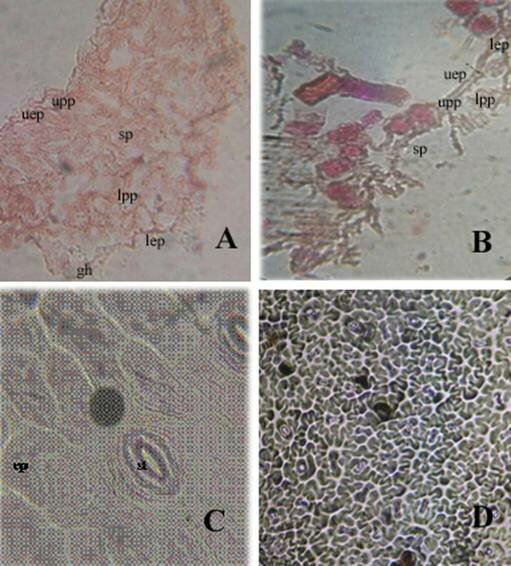
Morphological and anatomical investigations were carried out on two species of Jatropha: J. curcas and J. tanjorensis. These studies were carried out on the leaf and stem of these plants using the light microscope fitted with a Nikkon digital camera. Trichomes were observed in the leaf section of J. tanjorensis whereas these were lacking in J. curcas. The lower palisade parenchyma of J. tanjorensis consists of fewer layers but is thicker compared to that of J. curcas, which possessed more but thinner palisade layer. Key words: Morphological, anatomical, medicinal plants, Jatropha curcas, J. tanjorensis. IntroductionThe family Euphorbiaceae contains 290 genera and 750 species. They may be shrubs, trees and herbs, but rarely lianas. Many are xerophytes and cactoid and produce milky latex (Gill, 1988). The representatives Jatropha curcas and J. tanjorensis are of considerable economic importance as they provide food, drugs and may be cultivated as ornamentals. They are predominant in the tropics and subtropics. J. curcas is a shrub or tree dispersed and naturalized through the tropics, propagated by cuttings and seeds (Okujagu et al., 2005). The latex of J. curcas obtained directly from the stem of the plant can be applied directly to cuts, wounds and may be mixed with salt to clean the teeth. J. tanjorensis is a common weed of field crops, bush re-growth, roadside and disturbed places in the higher rainfall forest zones of West Africa including Nigeria. It is useful in herbal medicine, prepared locally in most parts of Southern Nigeria by collecting the leaves and squeezing out the juice. This is taken to reduce hypertension and also as malaria therapy. Anatomical study of medicinal plants is significant in pharmacognosy and to prevent adulteration as well as evolve the specific parameters for authenticity and quality control of raw drugs (Bernerjee and Mukherjee, 2001; Gupta et al., 2001). Earlier contributors to similar studies include Edeoga (1991), Ugborogho et al. (1992), Obute and Omotayo (1999), Edeoga and Eboka (2000), Idu et al. (2000), Gill and Mensah (2001). There is however a general dearth of information on J. tanjorensis, and no documented report about its anatomical features. Also, the physiognomic similarities between the two species under investigation require that further parameters be investigated in order to adequately separate them. The present study seeks to address some of these needs.
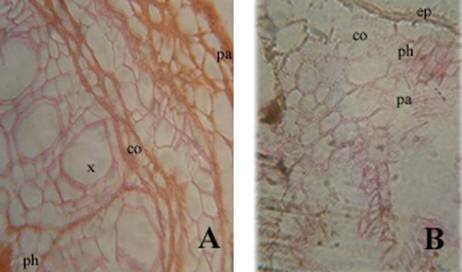
Materials and MethodsA sample of J. curcas was collected from the botanical garden in University of Benin while J. tanjorensis was collected from a home garden in BDPA, Ugbowo, Benin City, Edo State, Nigeria. The corresponding author properly identified both species. Morphological study was by physical observation and measurement of their fresh leaf and stem specimens. For the anatomical studies, the fresh samples were fixed in Booing fixative and cross sections obtained using a microtome (Johansen, 1940). The slide preparations were independently stained with heamatoxyline and safranin. A light microscope was used to view the slides and adjusted to finest resolution. Microphotographs were obtained using a Nikkon digital camera focused through the microscope eyepiece. The terminology of Metcalfe and Chalk (1950) was used in this report. Results and Discussion The anatomical features among the Jatropha species investigated were summarized in Table 1. While Figure 1 illustrates the transverse and abaxial microscopic views of J. tanjorensis and J. curcas leaves, while Figure 2 represents the microscopic anatomy of their stems. Morphologically, J. curcas are biennial or perennial herbs, woody at the base. Stem is erect, 1.80-7.0m, branched at the top. Leaves 10.0-15.0 cm x 9.0-12.5 cm, digitately veined and serrate to palmately lobed. While J. tanjorensis is an erect perennial herb 90-120m woody and branched at the base. Leaves 4.0-11.0 cm x 2.0-5.5 cm, palmately veined, palmately lobed, hastate and pubescent.
Table 1: Comparison of Anatomical Characteristics between J. curcas and J. tanjorensis.
Fig. 1. Photomicrographs of leaf sections (x40). A & B, Transverse section of J. tanjorensis and J. curcas respectively showing the structural arrangement of layers; C & D, Surface section (Abaxial) of J. tanjorensis and J. curcas respectively showing density of stomata and presence of trichomes: uep- Upper epidermis, upp- Upper palisade parenchyma, sp- Spongy parenchyma, lpp- Lower palisade parenchyma, lep- Lower epidermis, gh- Glandular hair, st- Stomata, ep- epidermis.
Fig. 2. Photomicrographs of T.S. of stem (x40). A & B, S. jamaicensis and S. cayennensis respectively showing structural pattern: ep- Epidermis, co- Collenchyma, pa- Parenchyma, ph- Phloem, x- Xylem.
Morphologically, the representatives were erect, branched and woody. The leaf surface of J. tanjorensis was pubescent while J. curcas was glabrous. Trichomes were present on the adaxial and abaxial surfaces of the leaf of J. tanjorensis being more prominent on the abaxial surface. The stem of J. curcas consists of thicker epidermal layer than that of J. tanjorensis whereas the reverse is true in their leaf anatomy. Major differences observed in the microscopic views included the following: The lower palisade parenchyma of J. tanjorensis consists of fewer layers but is thicker, while that of J. curcas are more but thinner (Table 1). Trichomes were observed in the leaf section of J. tanjorensis whereas these were lacking in J. curcas. There was also the presence of more stomata on the abaxial surface of J. tanjorensis. ReferencesBanerjee, G. and Mukherjee, A. 2001. Pharmacognostic studies on Portulaca oleracea L. I. Leaf. In Maheshwari, J.K. and Jain, A.P. (Eds.) Recent Researchs in Plant Anatomy and Morphology. Scientific Publishers (India), JODHPUR. Edeoga H.O. 1991. Comparative morphology of the leaf epidermis in Costus lucanusianus (Costaceae) complex and its systematic importance. Nigerian Annual National Science 1:25-30. Edeoga, H.O. and Eboka, A. U. 2000. Morphology of the leaf epidermis and systematics in some Dissotis Benth. species (Melastomataceae). Journal of Pure and Applied Sciences 6(2): 371 -374. Gill, L. S. 1988. Taxonomy of Flowering Plants. Africana-FEP Publishers Limited, Bamenda, Cameroon. 388p. Gill, L.S. and Mensah, J. K. 2001. Epidermal and leaf anatomical studies of the tribe Eragrostideae (Poaceae) from West Africa. Journal of Economic and Taxonomic Botany 19:41-58. Gupta, H.C., Kumar, S. and Rastogi, D. P. 2001. Comparative morpho-histological studies on two Jalapas. In Maheshwari, J.K. and Jain, A.P. (Eds.) Recent Researches in Plant Anatomy and Morphology. Scientific Publishers (India), JODHPUR. Idu, M., Olorunfemi, D. I. and Omonhinmin, A. C. 2000. Systematic value of stomata in some Nigerian hardwood species of Fabaceae. Plant Biosystem 134(1): 53-60. Johansen, D.A. 1940. Plant Micro-technique. McGraw- Hill New-York. 523p. Metcalfe, C. F. and Chalk, L. 1950. Anatomy of Dicotyledons. Oxford Clarendon Press, London. 1500p. Obute, G. C. and Omotayo, I. V. 1999. Macro and micromorphological evidence for infraspecific separation of taxa in Hibiscus Rosa sinensis L. (Malvaceae). Feddes Repert 110 (3-4): 201 208. Okujagu, T. F., Etaturie, S. O., Eze, I., Jimoh, B., Nwokeke, C., Mbaoji, C. and Mohammed, Z. 2005. Medicinal Plants of Nigeria. South West Nigeria. Volume 1. Nigeria Natural Medicine Development Agency, Lagos, Nigeria. 133p. Ugborogho, R. E., Ogunwenmo, K. O. and Aina, O. I. 1992. Epidermal morphology of six taxa of Ipomea L. in Nigeria. Feddes Reppert 103 (7-8): 543-550.
|
||||||||||||||||||||||||||||||||||||||||||||||||||||||||||||||||||||||||||||||||