SUSTAINABLE MARKET DEVELOPMENT FOR NON TIMBER FOREST PRODUCTS IN PAKISTAN
Abdul Latif and Zabta Khan Shinwari
Kohat University of Science & Technology, Kohat Pakistan
Abstract
Non timber forest products consist of goods of biological origin other than timber. Pakistan has great diversity in its relief feature, giving arise to unique floral compositions. 80% of the forest dwellers are dependant on NTFPs in one-way or the other due to poverty. Forest dweller relies on their indigenous knowledge for collection, processing, packing, drying, marketing and consumption of various non timber forest products (NTFPs). Some of the important NTFPs produced in Pakistan are; morels, honey, fruits and nuts, vegetable, condiments and spices, mazri palm, silk cocoon, and many other. 131 species are reported during the study. About 34% of local people are dependent on NTFPs for income generation. The prices and production of many NTFPs are fluctuating in different years. Some of NTFPs are exported, earning valuable foreign exchange like chalghoza, morels, walnuts etc. There was an export of 1384.72 million in 1999-00. These products, after collection and processing sold to the middleman who than sells into main market. 65% of the product is lost during the way to final product. The study reveals present situation of trade and marketing of NTFPs and future guidelines for proper planning and management.
___________________________________________________________________________________________________________
Key Words: Non timber forest products, Sustainable market development, Pakistan
OVERVIEW OF NTFPs IN PAKISTAN
Non-timber forest products (NTFPs) refer to a wide array of economic or subsistence materials that come from forests, excluding timber. Some of the important NTFPs are:
A) Food products
Morels/Mushrooms
Variety of morels are found in forest and rangelands, like Morchella esculenta, M. crassipes, M. vulgaris, M. deliciosa, Conocyba crispa, C. comatus, Cantharellus floccsus, M. conica, M. anqusticipt, Boletus luteus, other morels like oysters, padakis, lapoita, polyporus, Ink cap, earthstar and meadow mushroom etc (Rehman et al, 2000). In Pakistan, each year, local people collect about 55 to 65 tonnes of dried morels. More than 70% of morels are produced in NWFP (Iqbal, 1991), while 532,280 kg were produced in 1997-98 (EPB, 2002). Unit price of Morchella esculenta is Rs. 4000 to 4300 per kg at local grocers level while at middlemen level its price reaches to Rs. 5000-5500 per Kg (Adnan, 2002). Mushrooms are normally exported to France, UK, Italy, Switzerland, and Dubai etc. Its exports ranged from 150 to 160 million rupees (Iqbal, 1993). There was an export of Rs. 78,640,000 in 1999-00 (EPB, 2002). 70% decrease in exports was recorded in year 2000-01.
Honey
Honey is obtained from different bee species likes Apis cerana (Oriental bee), A. dorsa (Rock bee), A. florea (Little bee), A. mellifera (European bee) etc. Honey is extracted from wild, migratory and stationary beekeeping methods. Between 55 to 65 tonnes of honey is collected each year in the country from wild beehives. About 850 to 950 tonnes of honey is produced only in NWFP. Honey obtained from hill bee is 62.5 tonnes per year while Rock and European bee produces 66.2 tonnes and 133.3 tonnes year. According to statistics of Export Promotion Bureau, 2002, total production of honey was 4,647 tonnes. The price of honey depends on quality of honey. Price ranged from 100 to 350 rupees per kg, while prices of honey on roadside range from Rs 100 to 120 per kg. Although honey is produced in country but this production cannot meet the demand. That’s why Pakistan annually imports Rs. 3 to Rs. 4 million of honey (Iqbal, 1991). In 2000-01, honey of worth Rs. 471,547,000 (160/kg) was produced in the country (EPB, 2002).
Wild Fruits and Nuts
Various species of nuts are found in different areas of Pakistan. These species includes; pine nut or chalghoza (Pinus gerardiana) and walnuts (Juglans regia), wild persimmons (Diaspyros lotus), mulberry (Morus alba), wild fig (Ficus carica), guch (Viburnum nervosum), Jujube (Zizyphus spp). Other species of fruit trees are also available in some of the forest areas; these are Fig (Ficus carica L.), Guava (Psidium guajava L.), Gur gura (Monotheca buxifolia Falc.), Zarqoom (Opuntia monocantha), Tangoo (Pyrus pashia Ham Ex D. Don), Almond (Prunus amygdalus Batsch.), Pistachio Nut (Pistacia vera L.), Avocado (Mersea americania Mill.), Bair (Zizyphus mauritiana), Sapota/Sapodilla (Achras zapota) etc, (Iqbal, 1991: ASP, 1994).
Total production of pine nut in the country is estimated 21,000 tonnes. The price of pine nuts ranges from Rs 200 to 400 per kg and total value is worth of 37.5 million per year. In addition to domestic consumption, pine nuts are exported to the Middle East. Total exports of pine nuts in 1999-00 was $17.268 million i.e. 21.6% of total fruit exports. In case of walnut production, about 20,000 tonnes per year is produce. The price of walnuts ranged from 20 to 60 rupees per kg. Total annual value of walnut production is about Rs. 200 million. In case of other fruits, occasionally small quantities are brought into the local markets for sale. (Agriculture statistic of Pakistan, 2000-01).
Wild Vegetables
Various species are often found in the forest of Pakistan e, g Kachnar (Bauhinia variegate), Sohanja (drumstick, tree locally known for its partially opened inflorescences, eaten as a vegetable) (Moringa oleifera), Kunjai (Dryopteris felix-mas) Paizakey, Shalkhey, Panerik, Malkhozey, Warkharey, and Mathey etc (local names in Pushtoo). Kachnar‘s total production in Pakistan is estimated to be 30 tonnes, in which 20 tonnes are produced in NWFP. Wholesale price of Kachnar is Rs 5 to 10 per kg. There is small supply of about 10 tonnes of Suhanjna. Prices of Suhanjna ranges from Rs 7 to 8 per kg. Total production of Kunjai is 15 to 20 tonnes, all of which is used locally. Kunjai’s retail price is Rs. 7 to 8 per kg (Iqbal, 1991).
Condiments and Spices
These species includes; dried seeds of wild pomegranate (Punica granatum), locally known as "anar dana,”. They are used for producing sour taste in dishes. The total production of anar dana was 69 tonnes from whole country in 1999-00 (Agriculture Statistic of Pakistan, 99-00). The fruit yields 90 to 95 tons of dried seed and about 100 tonnes of skin. Tanneries in Punjab use the skin. The unit price of the anar dana is 110 to 120 per kg. While the wholesale price of caraway ranges from Rs 160 to 180 per kg. Most of the production of both species are consumed within the country. Caraway (Carum carvi) locally known as "Zeera Siah" is used for flavoring the bread, cakes, biscuits, and cheese. An averages shrub of Caraway (Carum carvi) yields 15 to 25 kg of fresh fruit and total production is about 300 tonnes. The caraway produced of worth 3.01 million rupees (Daud, 1994). The export of spices from Pakistan was 34,047 kg and 928,000 US$ in 2000-01(EPB, 2000).
B) Animal Products
Silk cocoons
Mulberry (Morus alba) is the key species for production of silk cocoons. Total production of dry silk cocoons was about 245 tonnes (RAPA, 1987). About 40,000 packets of silkseed were produced in country and supplied to the local and private rearers. The value of leaves required to rear one packet of silk seed is Rs 200 to 300 and it generating an income of Rs. 45.6 million to the silkworm rearers in the country. The unit price was 250 rupees per kg (Rs1,140 per packet) income of Rs. 10 millions per year. There are about 47.6 million rupee exports mainly to Japan and Korea (Iqbal, 1993).
C) Industrial Products
Vegetable tanning
Kikar or "babul" (Acacia nilotica) is main species of extracting vegetable tanning of hides in Pakistan. It is mainly used in leather tanning industry. Henna of commerce is the dried leaf of Lawsonia inermis L., a shrub or small tree, which is indigenous to the area between Pakistan, Iran and northern India. Total annual production of vegetable-tanned leather in the country is estimated at 40,000 tonnes. Annual consumption of babul bark is estimated at 84,000 tonnes. Bark of the tree is sold to crushing plants at Rs1.00 to 1.25 per kg. In the Gulf market, the value of black henna is twice as that of red henna. In 1992, prices ranged from approximately US$700/tonnes for top grades of Indian and Pakistani black henna, while its price is US$250/tonnes for the lowest grades (FAO, 1995).
Bhabar grass
These species includes Bhabar (Euliopsis binata), Sonagaria (Andropogon Schoenamthus), Biab grasses, Pataka (Abutilon bidentatum), Kana (Saccharum sp.) grasses etc. Pataka yields smooth silvery fibers used for making ropes and string for bed etc. About 605,040 kg were extracted from the circles of Sukker, Ghulam Mohammed Khan Barrage, Hyderabad Multan and Lahore from 1953-59 (Sheikh, 1972). The production of Pataka was about 80,000 kg in 1988. Another 500 to 600 tonnes of grasses are sold each year in local markets at Rs 1.50 per kilogram, for use as carpeting in mosques.
D) Fibers
Mazri leaves
Mazri is the local name for dwarf palm (Nannorrhops ritchiana). It is a gregarious, tufted, and shrubby palm, growing naturally in dry tropical regions of Pakistan. These fibers are widely used for preparation of mates, ropes, banns, ornamental products, different commodities for mosques, baskets, brooms, trays, hand fans, grain bins and cordage, cupboards and decoration pieces etc. Jandia (Kalpani, District Mardan), Swat, Totakan, Anbar, Kohat, Bannu in NWFP, Qasoor, Gujerat, Kot Addu in Punjab, Loralie, Sharag, Abdul Khail etc in Baluchistan are famous for various decorated and fascinating commodities. Average annual production of raw Mazri leaves in the country is 37,315 tonnes. Baluchistan is the biggest producer of the Mazri in Pakistan with average annual production 27,265 tonnes. About 3,400 tonnes of Mazri was produced in 1999-00 (Agriculture Statistic of Pakistan, 99-00). Average sale price of Mazri leaves in the Kohat district is Rs. 100 per 40 kg (Abbas, 2002). But in other areas like Kalpani (Mardan) its price was Rs. 210-220 per 40 kg. There was total exports of 126 millions rupees in 1991 from various products prepared by the rural people (Iqbal, 1991).
E) Miscellaneous Products
Oils
Main types of oils obtained, are caster oils, peppermint oil, menthol, lemon oil and orange oil, eucalyptus oil, olive (Olea europea), Avocado (Persea americana Mill.) and different types of nuts like Shinay nuts (Pistaca atlantica), P. chinensis, P. vera etc and walnuts (Juglans regia) etc are used for oil extraction (Daud, 1994). The production of caster oil was 174,770 kg in Multan and Lahore circles in 1957-58 (Sheikh, 1972). The consumption of all essential oils in Pakistan is 86,000 kg/annum. The exports of these essential oils were ranged between Rs. 1,799,000 and Rs. 10,403,000 (Daud, 1994).
Walnut bark
Bark is obtained from Juglans regia. Both the stem and roots are used for teeth cleaning by women, as it imparts a pinkish color to the lips. Prior to the ban, the bark was exported to the Middle East. The bark of the tree is removed by both the men and women, which is then dried and utilized. However, the removal of the bark adversely affects the tree growth or even kills the tree. That’s why Forest Department banned the transportation, selling and trading of the bark. Unit price of the bark is 65-75 rupees per kg.
Gums
Main specie for gum extraction is Acacia modesta (Palosa) and Acacia senegal (Gum Arabic). Women eat Palosa gum as a sweet. It is believed to restore vitality, particularly after childbirth. The Palosa tree starts production after 4 or 5 years yielding about 0.06 kilograms of gum. The gum is sold at price of Rs. 60 per kg, generating average revenue of Rs. 571 per family. Production figures for the entire country are not available. While the wholesale price of gum arabica was 14 rupees per kg in 1970 (Sheikh, 1972).
Basketry
For basketry, species of Tamarix dioica and mulberry are used. Total annual production is estimated to be 600,000 baskets, consuming 2,000 to 2,500 tonnes of raw materials each year. This produces revenue of Rs. 3 million each year (Iqbal, 1991). The baskets are transported to the nearby towns where they are sold to the shopkeepers at an average price of Rs.15 each.
Seabuckthorn
There are mainly 05 species found in mountainous areas of Pakistan. Important ones are Hippophae rhamonides and H. Salicifolia. They are white seabuckthorn or shallow thorn. They are found in Northern hilly regions at a height of 2000-3900 m. It is multipurpose, shrub type plant, used for fodder and fencing. It gives fruiting in three years time period. Fodder biomass of leaf is 2000-3000 kg/ha. Oils are extracted from the seed along with the juices. Each tree yielding 6 to 13 kg and 2-50 tonnes per hectors of fruit (Siddiqui, 1997). The slimy juice of plant also is having medicinal values.
METHODOLOGY OF THE STUDY
Though medicinal plants represent major chunk of NTFPs and many scientists have reviewed it (Shinwari et. al. 2003). Hence in the present study, it is excluded. The compilation of work is necessary not only for proper planning and management of NTFPs but also to get acquainted with present situation of NTFPs. While looking at greater dependence of the rural population on NTFPs, it is high time to review the current status of NTFPs for better planning and management. Based on review a strategy will be formulated on sustainable utilization of NTFPs. The methodology for the project was based on three material collection methods i.e.
· Literature Review
· Visit to various departments and Institutions
· Personal interviews
Available literature (books, journals, research papers and articles etc) about NTFPs was reviewed. Sources of these literatures were Pakistan Forest Institution (PFI), Weed Sciences Department, Agriculture University Peshawar, Forest Department, Peshawar, Wildlife Department N.W.F.P., Export Promotion Bureau (EPB), Peshawar, Central Library Peshawar University, and Internet etc. Personal observation and experience about various NTFPs in the market like prices and collection processes by local communities were also considered during study.
RESULTS AND DISCUSSION
Pakistan has diversity in its floral composition but status and potential of many NTFPs is still not fully understood and appreciated. There is a lack of actual production records for the majority of products and reliable data on the value of NTFPs used domestically do not exist. In addition, information on how to manage forests to yield a variety of products is insufficient. However, local people are utilizing NTFPs not only for the sake of their domestic but also for economic needs irrespective of conservation and sustainability in the harvesting or collection.
Production of Different NTFPs
The production of various Non-Timber Forest Products varies according to the favorability and suitability of climate, soil, and water. The amount of production changes from season to season in each year.
Based on data shown in the Table 1, production of resin is reduced 80-85%, which is mainly due to the ban by government. In international markets the value of crude resin is low, that’s why instead of extracting, govt. is importing resin. The synthetic products have also replaced resin. Mazri palm’s production was reduced to 70% in 1999-00 compared to 1991-92. But according to statistic of agriculture, in 2000-01, the production of Mazri increased to 95% as compared to that in 1999-00 i.e. 394,559 tonnes. Further details about production of various products are given in Table 1. Production of some products has been increased due to cultivation, proper technique development and management, and people and govt. attitude towards more profitable products etc.
Table 1 Shows Annual Production of various Non-Timber Forest Products
|
Products |
1991 - 92 tones |
1999-2000 tones |
|
Morels |
55 |
75.3 |
|
Honey |
1214 |
4647 |
|
Fruits |
21,800 |
- |
|
Walnuts |
20,000 |
- |
|
Vegetable |
60 |
- |
|
Condiments |
300 |
- |
|
Silk cocoons |
245 |
- |
|
Lac |
80 |
- |
|
Vegetable Tannin |
4,000 |
- |
|
Mazri leaves |
37,315 |
3400 |
|
Resins |
3,600 |
447 |
|
Bhaber grass |
993 |
- |
|
Soap nuts |
250 |
- |
Sources: Iqbal 1991, Iqbal 1993, EPB 2001
Some local communities are going for cultivation of various profitable products for their own needs or with the help of some institutions and programs/organizations. These products include; different types of morels, honey, Mazri palm, different types of vegetables and fruits, seabuckthorn, etc. So, the domestication different plants is increasing due to lesser availability of products extracted from the wild and some of the restrictions by government department like “Mazri Control Act, 1953”.
As current figure of various products was not available, however, if we do the comparison products-wise, then production of morels, honey, resin, and Mazri leaves was 8,569 tonnes in 1999-00 while production of these products was 42,184 tonnes in 1991-92. This comparison can be seen in Diagram 1. Seeing the actual figure honey and morel production was more but the production of other products like Mazri leaves and resin was less due to various bans and taxes.
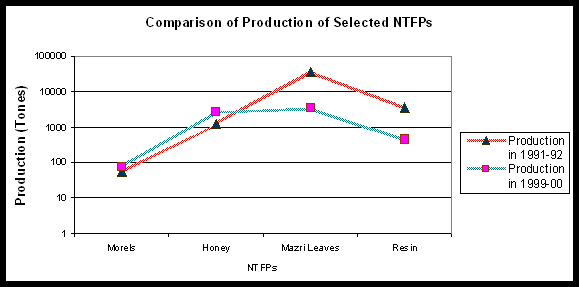 |
Diagram 1. Showing the Comparison of Selected NTFPs
Although limited amount of recent data was available but the overall situation of various NTFPs production fluctuate throughout the years due to seasonal variations, unfavorable climate, target group interest, previous year’s prices and market trends, quality of produce, bans and restriction etc. For example the production of Mazri palm and resin, which are the two important products but due ban by the forest department on their harvesting, collection or extraction, their production is reduced to 70%.
Prices of Various NTFPs
As the demands in international market changes, the rate of collection and production also changes. Simultaneously, the good price leads to high production and extraction. In past, the prices were too low as compared to present situation like the price of morels, especially Morchella esculenta, were 2,460 per kg in 1991 and now the prices range from Rs.4,300 to Rs. 7,000-7,500 per kg, while that price in 1960 was Rs. 80 per kg. This difference in price, is due to international market demand, better level income from morels and law of demand and supply. Similarly, the price of honey was Rs. 80 in 1991 and in 2002, its prices ranges from 210 to 280 per kg. If the prices are inflated at 10% per year (10 years 1*1010), then the inflation rate will be 2.59. If we multiply 2.59 with the baseline year’s price than resultant will give us the actual situation of increase or decrease in prices. For further details see Table 2.
Table 2 Shows the Prices of Different NTFPs in Pakistan
|
Price |
1991-92 (Rs. Per Kg) |
2001-02 (Rs. Per Kg) |
Inflated prices at 10% per year |
|
Morels (Morchella esculenta) |
2400 |
4300 |
6,216 |
|
Honey |
75 |
195.00 |
194.2 |
|
Walnuts |
12.00 |
30 |
31.0 |
|
Wild persimmons |
4 |
14.00 |
10.3 |
|
Chalghoza |
40 |
300.0 |
103.6 |
|
Kachnar |
5.00 |
12.00 |
12.9 |
|
Suhanjna |
8.00 |
15 |
20.7 |
|
Kunjai |
7.00 |
12.00 |
18 |
|
Anar Dana |
82.0 |
110.0 |
212.3 |
|
Caraway |
103.0 |
160.0 |
266.7 |
|
Silk Cocoons |
250.0 |
400.0 |
647.5 |
|
Resin |
28.07 |
35.50 |
72.7 |
|
Mazri |
2.45 |
6 |
6.3 |
|
Bamboo |
5 Ft |
12.00 Ft |
12.9 |
Note: The prices of different products are given at local
Level, which sell them to the middlemen or shopkeeper.
Table 2, shows that price of honey, Mazri, bamboo and kachnar etc remained the same, due to consumer interests in usage, synthetically produced substituted the products, demand in the market and availability in the markets etc. In case of morels the inflated price is 60% more than the current price of 4,300, which means that the prices of morels has been decreased. This may be due the unsustainable harvest by the local, external pressures on ecosystem, increase in population, lesser demand in importing countries due morels cultivation techniques development and quality of the produce. Similarly the prices of caraway, silk cocoon and anar dana has been also decreased due to synthetically produced products and demand in the markets. But the price of certain products has been increased like Chalghoza. Prices of Chalghoza increased 200% due to professional involvement of local people for more economic benefits, demand in international markets, supply to the international markets etc.

Diagram 2 Showing fluctuation in prices of various NTFPs in Pakistan
Exports of Different products
Pakistan is exporting different products to different countries of the world. Pakistan has a very separate place among other countries in products like walnuts, Chalghoza and mushrooms etc. The products are exported on the basis of demands of the importing country and international market trends. However there is fluctuation of exports as most of the products pass through traditional methods of processing and variation in climatic conditions. Some of the main international markets for the products are USA, UK, Switzerland, Italy, France, Spain, India, Middle East countries, etc.
Table 3 showing export of selected products from Pakistan
|
Name products |
Export (million Rs) |
Countries |
|
Mushrooms |
76.64 |
UK, France, Germany etc |
|
Pine nuts |
880.668 |
Middle east, European countries |
|
Walnuts |
200 |
Middle east etc |
|
Spices |
53.824 |
Middle east etc |
|
Silk cocoons |
47.6 |
Middle East etc |
|
Mazri |
126 |
Middle East etc |
|
Total |
1384.72 |
|
Sources: EPB, 2001, ASP, 2001, Ziaul, 2001.
Table 3 shows exports earnings from various products. Total exports were Rs 1384.72 millions in 1999-00. There is more potential of exports than the RS. 1384.72 millions, if various products are properly marketed and supply is maintained through sustainable harvest.
Material loss during collection, processing and marketing of various NTFPs
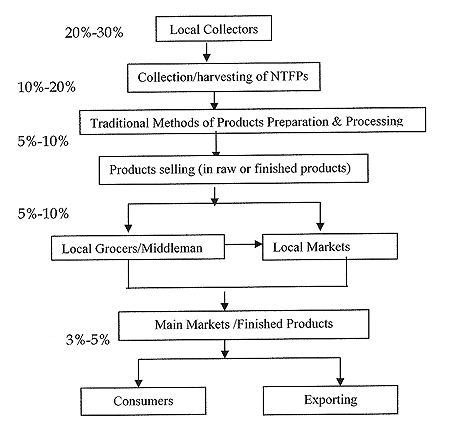
Diagram 4 Estimated loss of material during each step
During the whole process of NTFP collection and value addition, about 65-70% of material is lost. As there are mainly three levels i.e. local collector level, middlemen level and main market level. The diagram is showing various steps through which an NTFP has to pass. About 55% of the product material is lost at initial stages of the product collection and processing due to unawareness of local collectors about the sustainable harvesting of plants. 5-10% of the material is lost during the carriage, packing or value addition by middlemen into local markets or the main markets. Lastly about 5% is lost while giving the product finishing touch i.e. for consumer or exporting.
CONSTRAINTS/ PROBLEMS FACED TO NTFPS
Various constraints are faced to the trade and marketing of NTFPs in Pakistan. These constraints are unsustainable harvesting of various NTFPs, Old production technologies and methods, transportational facilities from place of harvest to main markets, fluctuating and lower prices, fluctuations in supplies, commercialization in production of the NTFPs, monopolies in the market, availability of good market for products and proper research on market development for NTFPs.
CONCLUSION
Pakistan has diverse flora and most rural people are utilizing various Non-Timber Forest Products (NTFPs). New varieties of various products are explored and utilized by the forest dwellers using their indigenous knowledge e,g Seabuckthorn (Hippophae rhamnoides) in the northern areas.
The rate of production as well as prices are undulating in different season, which is due to various interventions like lack of proper education of local people and in sufficient research and development, market trends and monopolies, wastage and unsustainability during different steps of processing, and govt. attitude toward NTFPs etc. So, there is need of proper assessment and research on each and individual product through bottom up approach for proper planning, better levels of production, sustainable income through sustainable utilization, training and capacity building of related personals and community for conservation of different forest resources.
RECOMMENDATIONS
1. Adopting the bottom-up approach for collection of base line information for individual products.
2. Mobilizing and educating the local people for sustainable use and proper management of different products, through proper programs and projects like Ethnobotany project, WWF-P.
3. Training to the communities through Village Base Organizations (VBOs) and Community Base Organizations (CBOs) for sustainable harvesting.
4. New markets have to be created for various products collected from the wild and cultivated, so that the community may be well benefited.
5. Proper advertisement and marketing of various products like Mazri, morels, honey, Seabuckthrone, fruits etc not only at national but also at international level has to be done for more foreign exchange and local benefits.
6. Proper monitoring of trade and marketing should be done for consistency in supplies of the products and monopoly of few buyers should be avoided.
7. Domestication and cultivation of various products through ex-situ conservation and community management in the prone areas where products are decreasing in their quantities.
8. For proper conservation and sustainable utilization, rules and regulations at community level is to be implemented, with the help of dignities of community, so that both goal of economic development and ecosystem conservation has to be achieved.
9. Place in the international market has to be created for various products prepared through improvement in the collection, drying, grading, packing and transporting, so that low production with better quality may yield better prices and benefits, while losses during these processes will pave the way towards sustainability of ecosystem.
10. Certification and standardization of various products processed in the home land and quarantine before export to the other countries
11. Prioritization of areas, species and communities especially in Swat, Hazara, Chitral, Northern Areas etc, where greater diversity and indigenous use is practiced. Making them Sustainable Forest Products Management through Protected Conservation Areas (PCAs) and Protected Area Management (PAM)
12. There is need for Products Conservation Plan (PCP) for each products e.g. making strategy for Mushrooms Production Areas or Honey Production Areas or Walnut Production Areas etc which may address priority species, sustainable harvesting, demand and supplies maintenance, market analysis and development, future status, preservation of indigenous knowledge etc.
REFERENCES
Abbas, Q. 2002. Ethnobotanical Studies of Kurram Agency through Rural Community Participation. Ethnobotany Project, WWF-Pakistan, Peshawar.
Adnan, S.M. 2002. Feasibility of Community Involvement in the Sustainable Use of Medicinal Plants in Roringar Valley, Swat. Ethnobotany Project WWF-P, Peshawar.
Agriculture Statistics of Pakistan, 1999. Ministry of Food and Agriculture. Govt. of Pakistan. Islamabad.
Agriculture Statistics of Pakistan, 1994. Ministry of Food and Agriculture. Govt. of Pakistan. Islamabad.
Agriculture Statistic of Pakistan, 1999-00, Ministry of Agriculture, Islamabad.
Daud, M. 1994. Proceedings of Herbs and Aromatic Plants. Agriculture Business Cell, Islamabad.
Export Promotion Bureau (NWFP). 1999-00. Foreign Trade Statistic of Pakistan, Export & re-exports. Peshawar, NWFP.
Export Promotion Bureau (EPB). 1997-98. Exporting Commodities of Pakistan. Ministry of Environment, Local Govt. and Rural Development, Islamabad.
Export Promotion Bureau (EPB). 2001-02. Exporting Commodities of Pakistan. Ministry of Environment, Local Govt. and Rural Development, Islamabad.
FAO. 1995. Beyond Timber: Social, Economic and Cultural Dimensions of Non Wood Forest Products in Asia and Pacific. Regional Office for Asia and Pacific (RAP), Bangkok.
GoP. 2001-02. Economic Survey of Pakistan. Economic Division, Islamabad.
Iqbal, M. 1991. Non-timber forest products: their income-generation potential for rural women in North West Frontier Province (Pakistan). International Labor Organization and Government of NWFP. Peshawar.
Iqbal, M. 1993. International trade in non-wood forest products. An overview. FAO. Rome.
Iqbal, M. 2002. NTFPs and land tenure and resource ownership: problems and opportunities. Research and Development, Forest Department, NWFP.
RAPA. 1987. Forest based rural enterprises in Pakistan. Regional Office for Asia and the Pacific (RAPA), Food and Agricultural Organization of the United Nations. Bangkok.
Rehman, T., Z.S. Syed & N. Rehman. 2000. Mushroom Cultivation, An Opportunity Seeking Business in Pakistan. NARC, Islamabad.
Sheikh, M.I. & M. Hafeez. 1972. Forests and forestry in Pakistan. Pakistan Forest Institute. Peshawar.
Siddiqui, K.M. 1997. Sea buckthorn (Hippophea rhamnoides) a Novel Fruit Plant for Mountainous Regions of Pakistan. PFI, Peshawar.
Shinwari. Z.K. A.S.Khan and T. Nakaike. 2003. Medicinal and other important plants of District Swat. Ethnobotany Project WWF-P, Peshawar.
Website. www.fao.org, November 2002. Food and Agriculture Organization.