|
Ethnobotanical Leaflets 13: 873-99, 2009.
A Floristic Description of Flora and Ethnobotany of Samahni Valley (A.K.), Pakistan
Tanveer Hussain and Muhammad Ishtiaq Ch.
Department of Botany The University of Azad Jammu and Kashmir Muzaffarabad, (A.K.) Pakistan
Corresponding authors: E-mail: ;
Issued July 01, 2009
Abstract The present study reveals a description of floristic features like life form, leaf size spectra and ethnobotany of valley Samahni. This study was carried out during the years 2006-2008, in Samahni valley district Bhimber A.K. (Pakistan), using methods consisting of semi-structured interviews employing a check list of questions, questionnaires, direct observations and biological inventories. It provides information about different local plants and their life form and leaf size spectra. 120 plant species recorded belonging to 46 families. Poaceae is the dominating with 14 members. Among these the most of the plants are used to cure common diseases like diarrhea, earache, fever, jaundice, flu, cough and other skin diseases. Snake bite, wound healing and burning of body part are also treated with local herbs. Many plants are used for multiple purposes like as medicines, food, fodder, fuel, furniture and shelter. Due to deforestation vegetation is eliminating rapidly. But the efforts and knowledge about plant wealth conservation is at initial stages. Megaphanerophytes are dominating followed by therophytes. Hemicryptophytes, Nanophanerophytes and Geophytes come after these respectively. All the types of vegetation depend upon presence of trees. In leaf size spectra Microphyllous are dominant followed by Megaphyllous. This work can be the base for advance research in different fields like phytochemistry, molecular biochemistry and antimicrobial plant secondary metabolites. For further research this ethnobotanical work is very important because it has come into existence with large experience of ancient history.
Keywords: Ethnobotany; Samahni valley; Muzaffarabad; Microphyllous; Megaphyllous.
Introduction Study area Samahni is a sub-division of district Bhimber and one of the most beautiful valleys of Azad Jammu and Kashmir. Scenic valley of Samahni is guarded by high mountains on all sides, offers breathtaking and mesmerizing natural scenes to its visitors, waterfalls come down mountain slopes as well as streams of crystal clear waters. The mountains across the whole valley dressed in jungles of pine trees add an extra touch to the stunning view. The valley holds a peaceful and calm atmosphere with pollution free environment from one end to the other. This valley is connected both with Mirpur & Bhimber through all weather black top roads. It is located 17km in the North of Bhimber City and 30km in the North-East of Mirpur. Geographically it is located near 33.05º latitude and 74.82 º longitude and falls in sub-tropic zone. The entire valley of Samahni is approximately 55 km long and 10 km wide. It has north facing and south facing high mountains, with 1000 altitude and variable topography. Northern and Eastern North boundary is attached with Indian occupied Kashmir at district Rajory. visiting sites Although the whole valley is beautiful and attractive for tourists but some places are especially famous for their watchfulness. Among them Baghser, Jandi Chontra, Peer Gali and Patti hill are remarkable. Indian occupied famous mountain “Reech Pahari” is also present in valley Samahni. Hydrography Many seasonal and permanent streams pass through the valley. The main stream originates form Kaman Gosha Hill in Indian occupied Kashmir. After passing through the valley Samahni, Bhimber and Gujrat it joins the river Chanab. The primary sources of water are springs and rain water. Topography The area is mountainous and semi-mountainous. Central semi-mountainous and agricultural fields are surrounded by 1000m high Altitude Mountains. The mountains have steep, gentle and moderate slopes. Climate The climate is at variance. The average maximum and minimum temperature is 28.9 ºC and 15.8 ºC respectively. June and July are the hottest months of the year with 38.18ºC and 37.18 º C average temperatures respectively. Highest temperature recorded during June and July is 40 degree centigrade. December and January are the coldest months of the year with 6.34ºC and 5.22ºC average temperatures respectively. Minimum temperature recorded during December is 3.2 degree centigrade (Table: 1). Rainfall The total average rainfall is about 1233mm/ year. Average rainfall is 102.8 mm/ month. High rainfall is recorded in July and August, 264.94 and 255.26 respectively. Rainfall is low in October and November, 31.68 and 16.82 respectively. Hails usually occur in February and March (Table: 1). Humidity Humidity remains high in rainy season and in winters. And it remains high at morning time than the evening. The average humidity at morning and evening is 69.0 % and 48.75 % respectively. The highest value of humidity is 83.4, recorded in August at morning. The lowest value of humidity is 29 recorded in the month of May at evening (Table: 1).
Table 1. Measurment of Temperature, Humidity and Rainfall of the Samahni Valley.
Ethnobotany Ethnobotany is the study of the relationship between plants and people: From"ethno" - study of people and "botany" - study of plants. Ethnobotany studies the complex relationships between (uses of) plants and cultures. The focus of ethnobotany is on how plants have been or are used, managed and perceived in human societies and includes plants used for food, medicine, cosmetics, dyeing, and textiles, for building, tools, clothing and social life. Ethnobotanical knowledge is as old as human civilization but the term ethnobotany was first coined by an American botanist, John Harshberger (1896). Manilal (1989) defines ethnobotany as the term today has come to denote the entire realm of direct relationship between plants and man. According to Arora (1997) ethnobotany in wider context denotes the entire realm of useful relationship between plants and man.
Life Form Plants were categorized into life form classes after Raunkiaer (1934). Christen Christensen Raunkiaer (1934) a Danish botanist devised a system of Classification of Life-form perennating buds, which carry the plants through the unfavourable seasons of the year. Raunkiaer's system is thus based on the position of the buds, or growing points, which renew plant growth. Raunkiaer's life form classes are as follows: I. Phanerophytes: A tall, woody or herbaceous perennial with resting buds more than 25cm above soil level, e.g. deciduous trees and shrubs. Phanerophytes are further divided into megaphanerophytes, mesophanerophytes, microphanerophytes and nanophanerophytes. II. Chamaephytes: perennating shoots or buds on the surface of the ground to about 25 cm above the surface - these buds can be protected by fallen leaves and snow: low bushes. III. Hemicryptophytes: perennating buds at the surface of the ground where they are protected by soil and leaves: grasses etc and rosette plants. IV. Geophytes: perennial buds buried in the ground on a bulb or rhizome, where they are protected from freezing or drying. V. Therophytes: Annuals, with a complete life cycle from seed to seed during one season, surviving unfavourable periods as seeds. Other specialized life forms which are not classified on the basis of their perennating organs are Succulents, Halophytes, and Epiphytes etc. Leaf size spectrum Oosting (1956) described that leaf size may help to understand the physiology of plant communities. Leaf spectra indicate the relationship of plants with area. There is a consistent variation of leaf, leaf size and texture between individual plants communities, these leaf characteristics also differ with various climatic conditions. Therefore leaf shape and size is an important physiognomic characteristic. The leaf classes are determined according to Raunkiaer’s diagram. There are four major classes. The lower limit of the size class is 25 sq. mm and each class is nine times larger than previous class. Ashby (1963) reported that in desert climate nanophanerophytes taking the form of the characteristic grey spiny brushes, are more numerous while during the brief rainy seasons therophytes spring up and colour the whole landscape. Therophytes slightly increase at high altitudes while the Geophytes also show the same trend. Batalha, M. A. & Martins, F.R. (2004) used Raunkiaer’s system to classify the plant from the site of Brazil. The most represented life forms were phanerophytes and hemicryptophytes. The vegetation presents a wide physiognomic variation from grasslands to woodlands. The life form spectrum differed significantly from Raunkiaer’s normal spectrum. Chapman, R. R. & Crow, G. E. (1981) evaluated the response of ground cover vegetation to prescribed fire in relation to the life form of individual plant species. Chamaeophytes were most severely affected by fire. Hemicryptophytes varied in their response and geophytes best survived the prescribed burn. Within each life form group variability existed in the modes of regeneration and recovery after burning. Costa, R. C. (2007) studied the flora and life form spectrum in an area of deciduous thorn woodland in northeastern, Brazil. They encountered 133 species belonging to 47 families. The herbaceous/woody ratio was 1.4. The life-form spectrum was characterized according Raunkiaer's system. The life-form spectrum observed was: therophytes (42.9%), phanerophytes (26.3%), Chamaeophytes (15.8%), hemicryptophytes (12.8%), and cryptophytes (2.3%). The present study indicates that the floristic richness of this biome has been underestimated. Dastagir G. et al., (2000) studied biological spectrum and did comparison of coefficient of communities between plant communities in Mai Dhani Hill Muzaffarabad. He reported that nanophanerophytes and hemicryptophytes increase as altitude increases while the megaphanerophytes decrease with increase in altitude. The tree layer is thinly dispersed and diversity of species decreased in December as compared to April. Gorsi M. S. & Shahzad R. (2002) documented the ethnomedicinal importance of Dirkot. They forced to start regeneration work to save the traditional knowledge about plants. Ishtiaq M. et al., (2006 b) stated that plants are indirectly associated to the culture and tradition of the people. They stated 36 plant species used for the treatment of sexual diseases and birth control rate in Samahni valley. The most of the plants used as decoction and infusions. This data shows the dependent of people in villages for their daily life needs and can provide the basis for further research. Ishtiaq M. et al., (2006 a) surveyed for the medicinal plants used only for animals. They provided the useful information about veterinary uses of plants. This ethnobotanical data has key role in life, society and economy of the people of the area and more over it can be initiative for phytochemical and pharmacological investigation about these medicinal plants. Nazir A. & Malik Z. H. (2006) stated the life form of district Kotli. They reported that qualitatively nanophanerophytes are dominant followed by therophytes, hemicryptophytes and megaphanerophytes. Nanophanerophytes were also dominant. They were followed by megaphanerophytes and hemicryptophytes. Therophytes and geophytes were low in number.
Materials and Methods Frequent visits were made in study area to collect the plants from the different localities of the area. Then their local names and parts used were recorded. To record local names, part uses interviews were conducted with local people in different villages individually. The altitude of the site from where the specimen is collected is taken with the help of Altimeter. Some useful discussions were held with some knowledgeable persons to confirm the information recorded from the informants. The collected specimens were dried and identified at herbarium placed in NARC (National agricultural research council) Pakistan. Results Table 2. Leaf Size Classes.
Table 3. Floristic Lists.
Floristic Competition of Area Among 46 recorded families the dominant family of the area is Poaceae with 14 species followed by Cucurbitaceae with 8 species. Family Moraceae and Solanaceae are third in this ranking with 7 species each. Rosaceae stands at forth place with 6 species. Amaranthaceae, Asteraceae, Brassicaceae, Euphorbiaceae, Mimosaceae, Oleaceae and Papilionaceae have 4 species each. Apiaceae, Liliaceae, Malvaceae, Acanthaceae, Anacardiaceae, Apocynaceae, Boraginaceae, Caeselpinaceae, Fabaceae, Lamiaceae, Myrtaceae, Rhamnaceae and Rutaceae have 3 species each. Acanthaceae, Anacardiaceae, Apocynaceae, Boraginaceae, Caeselpinaceae, Fabaceae, Lamiaceae, Myrtaceae, Rhamnaceae and Rutaceae have 2 species each. While other 21 families have only 1 species each (Table 4).
Table 4. Floristic Competition of Area.
Table 5. Classification of plants According to Life form & Leaf Spectra.
Key: L = Leptopohyll, N = Nanophyll, Mi = Microphyll, M = Megaphyll, MP = Megaphanerophytes, NP = Nanophanerophytes, H = Hemicryptophytes, G = Geophtes, Th = Therophytes
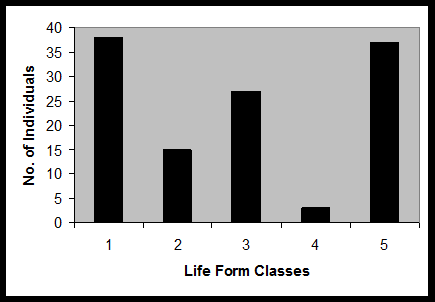
Table 6. Graphic Representation of Life Form Spectra. Megaphanerophytes are dominant with 38 species followed by Therophytes with 36 species. Nanophanerophytes are small in number while geophytes are rare with 3 species.
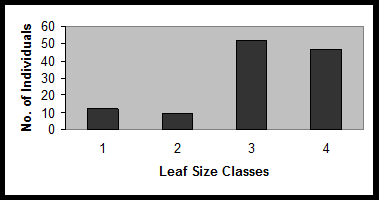
Table 7. Graphic Representations of Leaf Size Spectra. Microphyllous leaf type plants are leading with 52 species followed by megaphyllous plants with 47 species. Nanophanerophytes are small in number with 9 species.
Table 8. Rare Plants.
Table 9. Major vegetables of the Area.
Table 10. Major fruits of the Area.
Table 11. Cereal crops.
Table 12. Fuel wood and Furniture Plants.
Table 13. Plants used as Fodder.
Discussion Plants serve several critical functions in the biosphere. They regulate the flow of numerous biogeochemical cycles; it is also of great importance in local and global energy balances. Second, plants strongly affect soil characteristics, including soil volume, chemistry and texture. Third, they serve as wildlife habitat and the energy source for the bulk of animal species on the planet. Plants also critically important to the world economy, particularly in the use of fossil fuel as an energy sources. Perhaps most importantly, they are primary source of oxygen in the atmosphere, enabling the aerobic metabolism systems to evolve and persist. Lastly, vegetation is psychologically important to humans, who have direct contact with plants for food, wood, fuel, shelter, and medicine. The use of plants for the existence of human being is as old as practice as the human race itself. The accumulation of knowledge of plant use however co-evolved with human civilization through the experiential use of plants, generation after generation. The people of Samahni area depend mainly on plants for their food, fuel and for the treatment of common diseases. 120 species were recorded belonging to 46 families. Poaceae is the dominant family of the area. 101 species used as the treatment of common diseases. 67 species are used as food. 31 species are used as fodder for animals and 33 species used for fuel and furniture. Most plants are used as multiple purposes. Common diseases like fever, earache, toothache, asthma and other skin diseases are treated locally. snake bite and wound healing are also treated by local plant medicines. Most of the plants are eaten or their extract or decoction is prepared for the treatment of diseases. Some are applied externally especially in case of skin diseases. Usually herbs are used as medicines. In life form spectra Megaphanerophytes dominant with 38 species followed by Therophytes with 36 plant species and then Hemicryptophytes, Nanophanerophytes and geophytes come in dominating list. Nanophanerophytes and geophytes are very low in number with 15 and 3 species respectively. In leaf size spectra Microphyllous class is dominant followed by megaphyllous class. Leptophyll and Nanophyll classes have small number of representatives. The vegetation of the area is disturbed by the forest fire, deforestation and due shelling of Indian army. The main dependent of people for their fuel and furniture needs is directly on plant so forests are eliminating rapidly. In this situation precious plant wealth is in danger. During field survey some important plant species belonging to Megaphanerophytes are small in number. Among these Bauhinia variegata L, Cordia obliqa Wild, Ficus bengalensis L and Juglans regia L are near to extinct from the area. The production and growth of all other life forms depend upon the well growth and presence of Megaphanerophytes. But the knowledge and efforts to prevent the plant wealth from loss is on initial stages. It is needed that revolutionary steps should be taken to educate the people to abide by the laws and principles. Plantation campaigns ought to make. Only in this way we can save our valuable assets of plant diversity. References
Ahmad, H. et al., 2003, Ethnobotanical studies of some cultivated plants of Chhahh region (District-Attock) Pakistan. Scient. Khyb.,16(2):109-121. Arora, R.K. 1997. Ethnobotany and its role in the conservation and use of plant genetic resources in India. Ethnobotany 9: 6-15. Ashby, M. 1963, Introduction to Plant Ecology. Macmillan & Co. Ltd. New York: 93. Ashfaq, S. et al., 2004 Ethnomedicinal Observations of Medicinally Important Plants of Tehsil Fateh Jang, District Attock. Pak. J. Arid. Agric.7(1): 25-33. Batalha, M. A. & Martins, F.R. 2004. Floristic frequency and vegetation life form spectra of Cerrado site. Braz. J. Biol., 64(2): 203-209. Blasi, C. 1990, Life forms variability of Mediterranean sclerophyllous forests, Plant Ecology, 88(2): 93-102. Buot, J. I. E. & Okitsu, S. 1999. Leaf size zonation pattern of woody species along an altitudinal gradient on Mt. Pulog, Philippines. Vegetatio, 145(2): 197-208. Chapman, R. R. & Crow, G. E. 1981. Application of Raunkiaer's Life form System to Plant Species Survival After Fire. Bulletin of the Torrey Botanical Club, 108(4): 472-478. Costa, R. C. 2007. Flora and life-form spectrum in an area of deciduous thorn woodland (caatinga) in northeastern, Brazil. journal of arid environments, 68(2): 237-247. Cotton, C.M. 1996. Ethnobotany: Principles and Applications. Chichester: John Wiley and Sons. Dar M. E. 2003. Ethnobotanical uses of plants of Lawat district Muzaffarabad, Azad Kashmir. Asian journal of plant sciences, 2(9): 680-682. Dastagir G. et al., 2000. Biological spectrum and comparison of coefficient of communities between plant communities harbouring Mai Dhani Hill, near Muzaffarabad, (AJK). Pakistan journal of biological sciences, 3(2): 300-302. Gorsi M. S. & Shahzad R. 2002. Medicinal uses of plants with particular reference to the people of Dirkot, Azad Jammu & Kashmir. Asian journal of plant sciences, 1(3): 222-223. Haq, I. 1983. Medicinal Plants-Report of Committee on Economic and Therapeutic importance of Medicinal Plants. Ministry of Health. Government of Pakistan-Hamdard Foundation Press:1-13. Harshberger, J. W. 1896. The purpose of Ethnobotany, Botanical Gazette, 21: 146-154. Hocking, G. M. 1958. Pakistan Medicinal Plants I, Qualitas Plantarum Et. Material Vegetabiles., 5 : 145-153. Hunt, I. D. 2000. Ecological Ethnobotany: Stumbling Toward New Practices and Paradigms. MASA Journal, 16(1): 1-13. Hussain, F. et al., 1995. Vegetation studies of Girbanr Hills District Swat, Pakistan. Kor. J. Ecol. 18 : 207-218. Ishtiaq M. et al., 2006 a. Ethno veterinary medicinal uses of plants from Samahni valley dist. Bhimber, (AJK). Asian journal of plant sciences, 5(2): 390-396. Ishtiaq M. et al., 2006 b. An Ethnomedicinal inventory of plants used for family planning and sex diseases treatment in Samahni valley (AJK). Pakistan journal of biological sciences, 9(14): 2546-2555. Ishtiaq M. et al., 2007. An ethnobotanical survey and documentation of important medicinal folklore food phytonims of flora of Samahni valley, (Azad Kashmir) Pakistan. Pakistan journal of biological sciences, 10(13): 2241-2256. Jha, S. 2005. Comparative Analysis of the Flora of Morang District and Adjoining Areas of Nepal. Our Nature, (3): (63-68). Khan, A. U. 2002. History of decline and present status of natural tropical thorn forest in Punjab, Pakistan. Biol. Conser. 63(3): 250-210. Kosic, V. I. & Britvec, M. 2007. Plant Diversity of Pastures on the Family Farms in the Southern Part of Istria (Croatia). Agriculturae Conspectus Scientifi cus, 72(2): (141-147). Manilal, K.S. 1989. Linkages of ethnobotany with other sciences and disciplines. Ethnobotany 1: 15-24. Martin, G.J. 1995. Ethnobotany, A People and plants Conservation Manual. Chapma and Hall, London. Mashaly I. A. & Awad E. R. 2003. Weed flora of Orchards in the Nile delta, Egypt: Floristic features. Asian journal of plant sciences, 2(3): 314-324. 2(3): 314-324. Nazir A. & Malik Z. H. 2006. Life form and index of similarity of plant communities recorded at Sarsawa hills district Kotli. Journal of research (Science), 17(1): 27-33. Oosting, H. H, 1956. The study of plant communities. 2nd ed. W. H. Freeman & co Sanfrancisco: 69-78. Packham, J. R & Harding D. J. L. 1982, Ecology of woodland processes – contemporary biology. Edward Arnold Publisher Limited. London: 24-55. Pie, S.J. 1991. Mountain culture and forest management of Himalayas Himalayan Ecosys. 114-120 Posey, D. A. 1990 Intellectual property rights: what is the position of ethnobiology? Journal of Ethnobiology 10(1): 93-98 Qureshi, R.A. et al., 2007.Ethnobotanical studies with special reference to plants phenology at Sudhan Gali and Ganga Choti hills (District Bagh, A.K.). Electronic journal of Environmental, Agricultural and Food Chemistry, 6(7): (2207-2215). Raunkiaer, C. (1934) The life forms of plants and statistical plant geography Oxford Clarendon Press: 632. Sandhya, B. et al., 2006. Ethnomedicinal plants used by the valaiyan community of Piranmalai hills (Reserved Forest), Tamilnadu, India – A Pilot Study. Afr. J. Traditional, Complementary and Alternative Medicines, 3 (1): 101 – 114. Shahbaz, B. et al., 2006. A Critical analysis of forest policies of Pakistan: implication for sustainable livelihoods. Mitigation and Adaptation Strategies for Global Change. DOI: 10.1007/s11027-006-9050-9 Shinwari, M.I. and Khan, M.A. 1998. Ethnobotany of Margalla Hills. National Park, Islamabad. Dept. of Biological Sciences, Q.A.U.: 1-5, 28-31, 47-76 ,125-131. Shinwari, Z. K. and Gilani, S. S. 2003. Sustainable harvest of medicinal plants at Bulashbar Nullah, Astore (Northern Pakistan). Journal of Ethnopharmacology, 84(2-3): 289-298. Shinwari, Z.K. and Malik, S. 1989. Plant Wealth of Dera Bughti area, Progressive Farming., 9: 39-42. Tareen, R. B. & Qadir, S. A. 1993, life form and leaf size spectra of the plant communities of diverse areas ranging from Harnai, Sinjwai to Duki regions of Pakistan. Pak. J. Bot., 25: 83. Vartak, V.D. & Gadgil, M. 1980. Studies in ethnobotany – A new vistas in botanical science. Biovigyanam, 6: 151-156. Yilmaz H. et al., 2003. Natural plants for use in rock and dry wall gardens at high altitude areas. Asian journal of plant sciences, 2(10): 761-767. Zafar M. et al., 2003.Taxonomical description and ethnobotanical survey for indigenous use of some medicinal plants of Rawalpindi district. Asian journal of plant sciences, 2(6): 475-47.
|
|||||||||||||||||||||||||||||||||||||||||||||||||||||||||||||||||||||||||||||||||||||||||||||||||||||||||||||||||||||||||||||||||||||||||||||||||||||||||||||||||||||||||||||||||||||||||||||||||||||||||||||||||||||||||||||||||||||||||||||||||||||||||||||||||||||||||||||||||||||||||||||||||||||||||||||||||||||||||||||||||||||||||||||||||||||||||||||||||||||||||||||||||||||||||||||||||||||||||||||||||||||||||||||||||||||||||||||||||||||||||||||||||||||||||||||||||||||||||||||||||||||||||||||||||||||||||||||||||||||||||||||||||||||||||||||||||||||||||||||||||||||||||||||||||||||||||||||||||||||||||||||||||||||||||||||||||||||||||||||||||||||||||||||||||||||||||||||||||||||||||||||||||||||||||||||||||||||||||||||||||||||||||||||||||||||||||||||||||||||||||||||||||||||||||||||||||||||||||||||||||||||||||||||||||||||||||||||||||||||||||||||||||||||||||||||||||||||||||||||||||||||||||||||||||||||||||||||||||||||||||||||||||||||||||||||||||||||||||||||||||||||||||||||||||||||||||||||||||||||||