Withaferin-A: A Potential Anticancer Withanolide from Withania somnifera (L.) Dun.
Abstract
Author: Dr Amrit Pal Singh, MD (Alternative Medicine), Medical
Executive, Ind –Swift Ltd.
Address for correspondence:
Dr Amrit Pal Singh
House No: 2101 Phase-7
Mohali –160062.
Email: [email protected]
Withania somnifera (Ashwagandha) is a plant used in medicine from the time of Ayurveda, the ancient system of Indian medicine. The dried roots of the plant are used in the treatment of nervous and sexual disorders. From chemistry point of view, the drug contains group of biologically active constituents known as withanolides. The chemical structures of withanolides have been studied and they are widely distributed in family Solanacae. Withaferin- A is therapeutically active withanolide reported to be present in leaves. In animal studies, withaferin-A has shown significant anticancer activity. Majority of the anticancer drugs like Vinblastine, Vincristine, and Taxol have been derived from green flora. Today there is much interest in natural products with anticancer activity. Withanolides are of under research potential as far treatment of cancer is concerned. The article reviews the scope of studies published in favor of anticancer potential of withaferin-A.
(Key words: Withania somnifera/ Withanolides/Withaferin-A.)
Introduction and chemistry
Withanolides are group of pharmacologically active compounds present in roots and leaves of Withania somnifera. The extract of the plant available in the market is standardised to withanolide content. . The chemistry of withanolides has been studied and they are basically steroidal lactones (highly oxygenated C-28 steroid derivatives). Withanolides are similar to ginsenosides (the active constituents of Panax ginseng) in structure and activity. They are believed to be immunomodulator, which most probably accounts for anticancer activity.
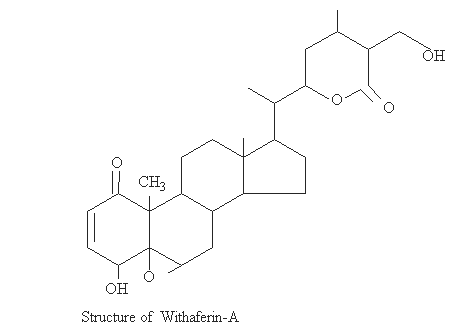
Withaferin-A has been assigned following structure: -
 |
Anticancer studies
1.Withaferin- A, isolated from the roots of Withania somnifera, reduced survival of V79 cells in a dose-dependent manner. LD50 for survival was 16 microM. One-hour treatment with a non-toxic dose of 2.1 microM before irradiation significantly enhanced cell killing, giving a sensitizer enhancement ratio (SER) of 1.5 for 37% survival and 1.4 for 10% survival. SER increased with drug dose, but at higher doses the increased lethality appears to be due to two effects-- drug toxicity and radiosensitization. The drug induced a G2/M block, with a maximum accumulation of cells in G2-M phase at 4 h after treatment with 10.5 microM withaferin A in 1 h.
2.Withaferin- A showed marked tumour-inhibitory activity when tested in vitro against cells derived from human carcinoma of nasopharynx (KB). It also acted as a mitotic poison arresting the division of cultured human larynx carcinoma cells at metaphase and in HeLa cultures similar to star -metaphase. It also produced significant retardation of the growth of Ehrlich ascites carcinoma, Sarcoma 180, Sarcoma Black (SBL), and E 0771 mammary adenocarcinoma in mice in doses of 10, 12, 15 mg./kg. body-wt. Growth of Ehrlich ascites carcinoma was completely inhibited in more than half the mice, which survived for 100 days without the evidence of growth of the tumour. Withaferin A caused mitotic arrest in embryonal chicken fibroblast cells.
3.The alcoholic extract of the dried roots of the plant as well as the active component withaferin- A isolated from the extract showed significant antitumor and radiosensitizing effects in experimental tumors in vivo, without any noticeable systemic toxicity. Withaferin A gave a sensitizer enhancement ratio of 1.5 for in vitro cell killing of V79 Chinese hamster cells at a non-toxic concentration of approximately 2 microM. The mechanism of action of this compound is not known.
Conclusion: The studies so far indicate that W. somnifera could prove to be a good natural source of a potent and relatively safe radiosensitizer/chemotherapeutic agent.
References:
1.Ali, M., M. Shuaib, et al. (1997). Withanolides from the stem bark of Withania somnifera. Phytochemistry Oxford 44(6): 1163-1168. Fac. Pharmacy, Jamia Hamdard, PO Hamdard Nagar, New Delhi-110062, India.
2. Fuska, J., B. Proska, J.S. Williamson and J. Rosazza Microbiological and Chemical Dehydrogenation of withaferin-A Folia Microbiol. (Prague), 1987, 32:112-115.
3. Gupta, A. P., R. K. Verma, et al. (1996). Quantitative determination of withaferin- A in different plant parts of Withania somnifera by TLC densitometry. Journal of Medicinal and Aromatic Plant Sciences 18(4): 788-790. {a} Central Inst. Med. Aromatic Plants, Lucknow 226 015, India.
4. Devi PU Akagi K Ostapenko V Tanaka Y Sugahara T. Withaferin- A: a new radiosensitizer from the Indian medicinal plant Withania somnifera. In: Int J Radiat Biol (1996 Feb) 69(2): 193-7.
5. Kupchan et al., J. Amer. chem. Soc., 1965, 87, 5805; Shohat et al., loc. cit.; Chem. Abstr.1973, 79, 139; 1970, 72, 130740; Lavie et al., J. chem. Soc., 1965, 75171.
6. Devi PU. Withania somnifera Dunal (Ashwagandha): potential plant source of a promising drug for cancer chemotherapy and radiosensitization. Indian J Exp Biol 1996; 34:927-932.
7. Uma, D. P., K. Akagi, et al. (1996). Withaferin -A: A new radiosensitizer from the Indian medicinal plant Withania somnifera. International Journal of Radiation Biology 69(2): 193-197. {a} Dep. Radiobiol, Kasturba Med. Coll., Manipal 576 119, India.
8.B.Kaufmann /S.Souverain /S.Cherkaoui /P.Christen /J.-L.Veuthey. Rapid Liquid Chromatographic-Mass Spectrometric Analysis of Withanolides in Crude Plant Extracts by Use of a Monolithic Column.